
How Puppies Learn
Here's the good news and the bad news. We are training our puppies all the time! You may think that you train only when you're working on skills or behaviors, but puppy is paying attention to you even when you're not aware of it. Let's dig a little deeper so we can train more effectively and puppy can learn more quickly.
OPERANT CONDITIONING

Don't be put off by the words, "operant conditioning." It's easy to understand if we translate that to, "behaviors have consequences."
In the chart to the left (click to make it larger), you'll see that there are four types of consequences. Two are consequences where something is added to the behavior ("positive"), and two are consequences where something is delayed or withheld ("negative").
With force-free training, we want to stay on the green side of the chart: adding something good to increase a behavior or withholding or delaying something good to fade the behavior.
BY ASSOCIATION
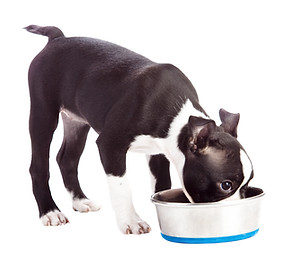
Puppies are constantly learning by association. Does your puppy get excited when they see their food bowl? They've learned by association: bowl = food.
Association works in the other direction, too. If we yell at puppy when they bark at another dog, puppy associates the unpleasant sound of our yelling with the other dog. They've learned by association: dog = bad sound.
Is there an alternative to this negative association? Yes! As soon as puppy sees another dog, but before they have a chance to bark, offer a yummy treat. Voila! New association: dog = yummy treat
BY CONSEQUENCE

Let's say you are teaching puppy a new skill, like down. Puppy gets almost all the way to down, but from your perspective, down is all the way down. So puppy jumps up, feeling that what they did wasn't what you wanted. "Let's try something else," puppy thinks.
Here's another possibility. Puppy gets almost all the way to down, and you mark the behavior (click or "yes!"), followed by a treat. Puppy now knows that this behavior has a good consequence. And you are well on your way to training a solid "down," offering a good consequence at each progressive step.
FLUENCY & GENERALIZATION
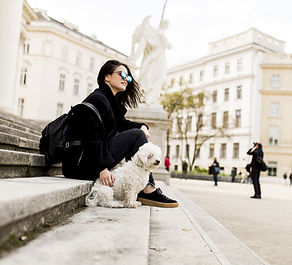
Unlike humans, puppies don't "do" logic or rational thinking. And they don't generalize. Have you noticed that when you ask for a familiar behavior in a new location, puppy seems to have no idea what to do? They aren't being stubborn or disobedient; they literally don't understand.
This is why, once puppy has mastered a skill in one location or situation, we train the same skill in a new location or situation, under different conditions. The skill becomes fluent and, with enough repetition, the skill is generalized.